Abstract:
Recently, Prof. Guanghao Rui from the School of Electronic Science and Engineering at Southeast University developed a high-Q all-dielectric achiral metasurface capable of generating strongly localized superchiral near fields in the near-infrared region. This platform enables the detection of D/L-tryptophan enantiomers and the identification of protein secondary structures at picogram-level adsorption quantities. The related work, entitled “Enantiomeric and protein structural sensing via high-Q all-dielectric metasurfaces,” has been published inAdvanced Photonics.
1. Research Background
Chirality is ubiquitous in important biological molecules, including amino acids, nucleic acids, proteins, and chiral pharmaceuticals. Although enantiomers possess identical molecular compositions, they can exhibit remarkably different or even opposite biological functions. Therefore, achieving highly sensitive detection of trace chiral biomolecules is of great importance for disease diagnosis, drug development, and life science research.Circular dichroism (CD) spectroscopy is a powerful non-invasive technique for characterizing molecular chirality and protein secondary structures. However, because biomolecules are much smaller than the wavelength of light, their interaction with electromagnetic fields is intrinsically weak. This challenge becomes more pronounced in the near-infrared (NIR) region, where the intrinsic CD responses of molecules are further reduced, making direct detection of trace-level samples difficult.Localized superchiral optical fields can significantly enhance the interaction between chiral light and molecules. Compared with metallic nanostructures, all-dielectric metasurfaces offer advantages including low optical loss, reduced photothermal effects, and excellent biocompatibility. Nevertheless, achieving high-Q resonances while maintaining structural achirality and low background signals, as well as ensuring sufficient spatial overlap between molecules and near-field hotspots, remains a key challenge for improving chiral sensing performance.
2. Research Content and Highlights
The research team designed and experimentally demonstrated an all-dielectric achiral metasurface composed of amorphous silicon nanocubes containing a central air microcavity. The proposed structure simultaneously supports a low-Q magnetic dipole guided-mode resonance and a high-Q toroidal dipole quasi-bound state in the continuum (quasi-BIC), generating strongly localized superchiral near fields around the air microcavity. This platform provides a highly sensitive optical probe for near-infrared chiral molecular detection.Experimental results demonstrate that the metasurface can distinguish D- and L-tryptophan enantiomers under trace-level sample conditions by exploiting their opposite-sign and comparable-amplitude CD responses. Furthermore, through resonance wavelength shifts and differences in surface sensitivity, the platform enables label-free discrimination of protein secondary structures dominated byα-helical orβ-sheet configurations at picogram-level surface adsorption quantities.
The study further reveals that the Q factor is not the sole determinant of sensing performance; the spatial overlap between molecules and superchiral near-field hotspots plays an equally critical role. Theoretically, the high-Q mode can provide an enhancement upper limit of approximately 250-fold. Under the current surface adsorption conditions, molecules exhibit stronger spatial overlap with the hotspots of the low-Q mode, and therefore the experimentally observed CD signals are primarily contributed by the more robust low-Q resonance.In the future, integrating microfluidic delivery, nanoscale positioning, or single-molecule manipulation technologies could enable targeted transport and confinement of molecules within the central air microcavity, thereby fully exploiting the enhancement potential of the high-Q mode. Such advances may further extend the platform toward applications including single-molecule chiral readout, dynamic monitoring of protein conformational changes, and chiral drug screening.
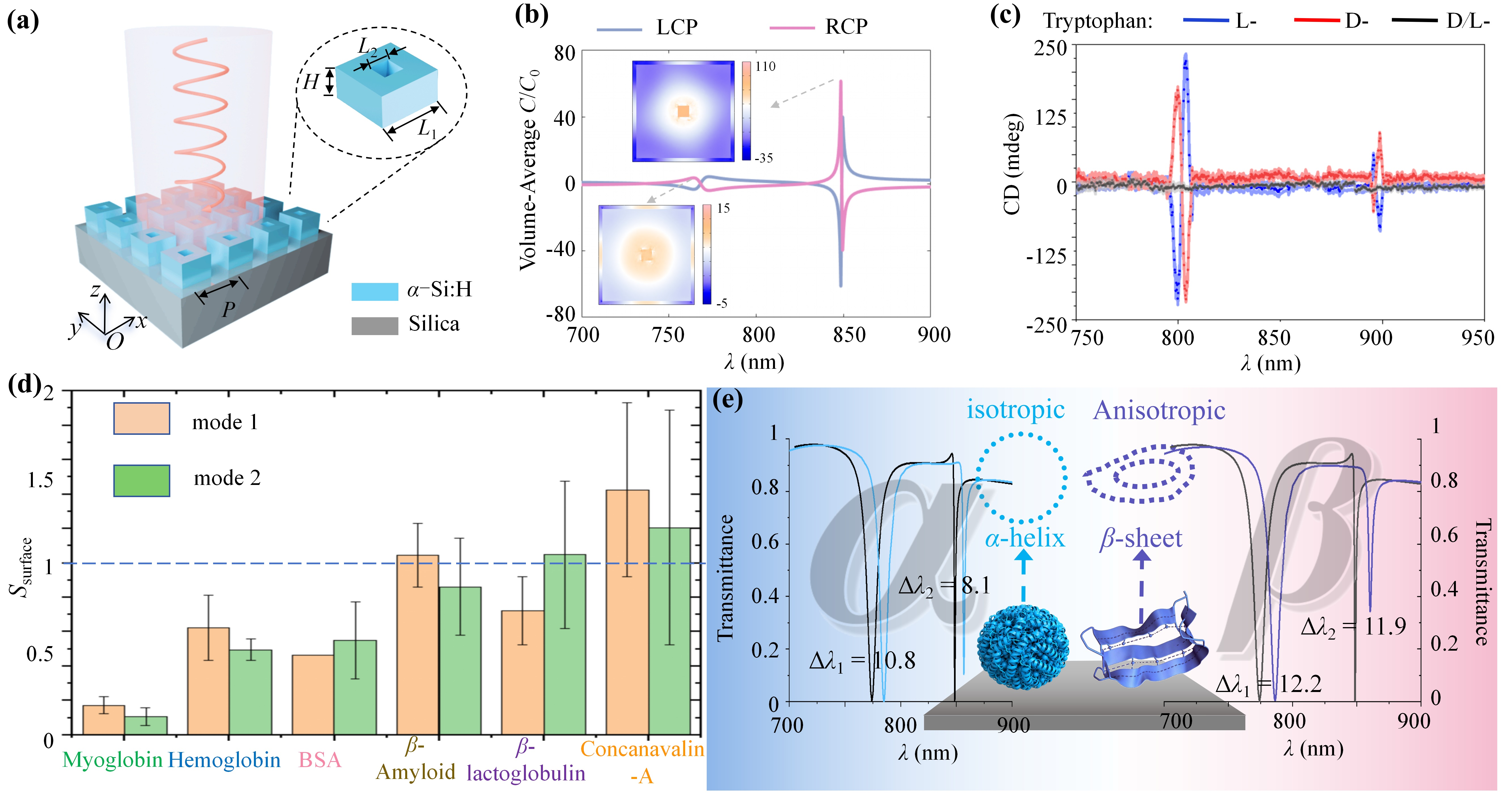
Figure 1. Chiral and protein structural sensing enabled by a high-Q all-dielectric achiral metasurface.(a) Schematic illustration of the amorphous silicon nanocube structure containing a central air microcavity.(b) Volume-averaged superchirality factor within the air microcavity and the corresponding near-field distributions at characteristic wavelengths.(c) CD spectra of tryptophan enantiomers.(d) Surface sensitivities for different proteins.(e) Spectral shifts induced by thin protein layers dominated byα-helical and β-sheet secondary structures.
3. Authors and Publication Information
Tianxu Jia, a Ph.D. candidate from the School of Electronic Science and Engineering at Southeast University, Xiaotong Li, and Youngsun Jeon from POSTECH are the co-first authors of this work. Prof. Guanghao Rui from Southeast University, Prof. Qiwen Zhan from Westlake University, and Prof. Junsuk Rho from POSTECH are the co-corresponding authors.This research was supported by the National Natural Science Foundation of China, the Natural Science Foundation of Jiangsu Province, and other funding programs.
Title: Enantiomeric and protein structural sensing via high-Q all-dielectric metasurfaces
Journal:Advanced Photonics, 8(5), 056004 (2026).
DOI: //doi.org/10.1117/1.AP.8.5.056004